
The Battlefield Theologian Doctrinal Manifesto
Preamble
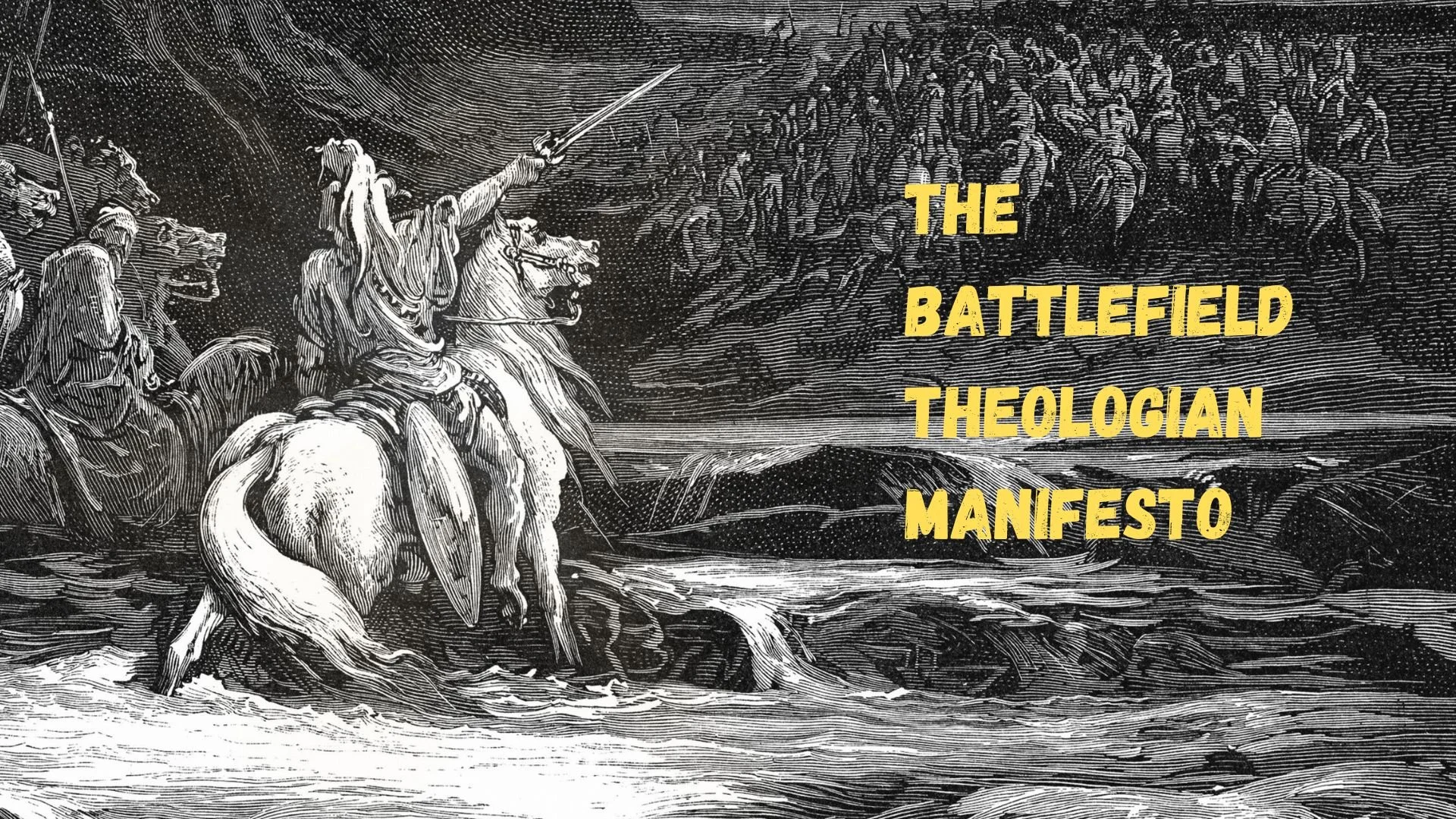
I am writing this with the Saints of 5 Bridges Church in mind, and for those moving to the area who wish to understand my theological conviction and where I stand on several critical items that demand clarity and distinctions. We live in an era in which many congregants, members, or visitors of a local church do not know where their pastor stands on these issues. I believe that, as a pastor, it is my duty to be transparent with the people the Lord has placed in my care as a spiritual shepherd for their souls. I pray that this doctrinal manifesto provides clarity rather than confusion and strengthens those brothers and sisters who are members of 5 Bridges Church. I am calling it “The Battlefield Theologian Manifesto” as that is how I view the Christians duty in the 21st century. A “Battlefield Theologian “is a Christian who forges doctrine in submission to Scripture while standing in the real conflicts of the church and the world, refusing both academic detachment and cultural compromise, and remaining faithful to Christ amid pressure, opposition, and suffering.The Battlefield Theologian doctrinal manifesto exists to articulate, without apology or ambiguity, the theological convictions, interpretive commitments, and pastoral instincts that govern all teaching, writing, preaching, and public engagement of Ethan Jago. This manifesto is not speculative, experimental, or trend-responsive. It is confessional, Scripture-bound, historically conscious, and pastorally accountable. It reflects a settled conviction that the church does not need novelty, relevance strategies, or ideological accommodation, but faithfulness to the Word of God, loyalty to Christ, and courage in an age of compromise.
What follows is not an exhaustive systematic theology, but a governing doctrinal charter that establishes boundaries, priorities, and instincts. These convictions are held as matters of conscience before God and are treated as non-negotiable guardrails for why I write what I write, and what I believe regarding the teaching of sacred Scripture.
1. Scripture (Bibliology)
Holy Scripture is the inspired, inerrant, infallible, and sufficient Word of God. All sixty-six books of the Old and New Testaments are God-breathed and constitute the final authority for faith, doctrine, worship, ethics, and church life. Scripture does not merely contain the Word of God; it is the Word of God.
The Bible is perspicuous in all matters necessary for salvation and godliness. While not all passages are equally clear, no external authority, scientific consensus, cultural pressure, ecclesial tradition, personal experience, or emotional intuition may sit in judgment over Scripture. Scripture interprets Scripture, and its meaning is determined by authorial intent under the inspiration of the Holy Spirit.
Any hermeneutic that requires Scripture to be reinterpreted to accommodate modern sensibilities, scientific theories, or ideological frameworks is rejected as unfaithful. Where Scripture speaks, God speaks, and the church must submit.
2. Hermeneutics (Biblical Interpretation)
The grammatical-historical method governs all interpretation. Texts are read according to their literary genre, grammatical structure, historical context, covenantal placement, and redemptive‑historical flow. Meaning is not discovered through reader experience but through careful attention to what the biblical authors intended to communicate.
Narrative texts are interpreted as redemptive‑historical accounts, not as normative blueprints unless explicitly universalized by Scripture. Descriptive passages are not automatically prescriptive. The New Testament epistles provide doctrinal clarity that governs the interpretation of narrative.
All preaching and teaching follow a consistent movement from text → doctrine → warning → exhortation → obedience, grounded in grace and union with Christ. Moralism, allegory detached from authorial intent, speculative theology, and experiential reinterpretation are rejected.
3. God (Theology Proper)
God is eternally existent in three persons, Father, Son, and Holy Spirit, equal in essence, power, glory, and authority. He is holy, sovereign, immutable, omniscient, omnipotent, omnipresent, and perfectly good. God ordains whatsoever comes to pass, yet without being the author of sin.
God governs all things according to His eternal decree, accomplishing His purposes through primary and secondary causes. His sovereignty extends over creation, redemption, history, nations, rulers, suffering, and salvation. Nothing occurs outside His will, and nothing frustrates His purposes.
4. Christ (Christology)
Jesus Christ is the eternal Son of God, truly God and truly man, one person with two natures united without confusion, change, division, or separation. He is eternally begotten of the Father, conceived by the Holy Spirit, born of the virgin Mary, and lived a sinless life in perfect obedience to the Law.
Christ is the exclusive mediator between God and man. Through His substitutionary atonement, bodily resurrection, ascension, and heavenly intercession, He accomplished redemption for His people once and for all. Salvation is found in no other name.
The resurrection of Christ is a historical, bodily, public event, attested by Scripture and eyewitness testimony. Without the resurrection, Christianity collapses. Because Christ lives, justification is secure, sanctification is possible, and glorification is certain.
5. The Holy Spirit (Pneumatology)
The Holy Spirit is fully God, coequal and coeternal with the Father and the Son. He regenerates sinners, indwells believers at conversion, illuminates Scripture, sanctifies the saints, and glorifies Christ.
Spirit baptism occurs at conversion and unites believers to Christ and His body. The extraordinary sign gifts recorded in Acts functioned as covenantal and apostolic authentication during a redemptive‑historical transition and are not normative for the church today.
The Spirit never contradicts Scripture, never elevates experience above truth, and never draws attention to Himself apart from Christ. All claims of spiritual power must submit to the authority of the Word.
6. Salvation (Soteriology)
Salvation is by grace alone, through faith alone, in Christ alone, according to Scripture alone, for the glory of God alone. Fallen humanity is spiritually dead, unable to contribute to its own salvation. Regeneration precedes faith and is the sovereign work of God.
Election is unconditional and rooted in God’s mercy, not human merit or foreseen faith. Christ’s atonement effectively secures redemption for His people. Those whom God justifies, He will also sanctify and glorify.
Union with Christ is the foundation of the Christian life. Sanctification is both definitive and progressive, flowing from identity rather than performance. True grace produces obedience, holiness, and perseverance.
7. Creation and Authority (Genesis and Biblical Worldview)
God created all things ex nihilo in six literal, historical, twenty-four-hour days. Adam and Eve were historical individuals, created in the image of God, and their fall introduced sin and death into the world.
The authority of Scripture stands or falls at Genesis. Any attempt to reinterpret creation to accommodate secular science undermines biblical authority and introduces hermeneutical instability. Scripture does not require external validation to be true.
8. The Church (Ecclesiology)
The church is the household of God, the body of Christ, and the pillar and support of the truth. Christ alone is the head of the church. The local church is the primary means by which God gathers, sanctifies, and preserves His people.
Biblical church order includes qualified elders and deacons, Word-centered worship, church discipline, and covenantal membership. Leadership is rooted in character, doctrine, and accountability, not charisma or platform.
Mercy ministries are necessary but ordered. The household of faith is the first priority, and benevolence must be stewarded with wisdom, accountability, and doctrinal clarity.
9. Suffering, Perseverance, and the Christian Life
The Christian life is marked by suffering, discipline, and perseverance. Faithfulness to Christ often results in marginalization, loss, and opposition. These are not signs of failure but fellowship with Christ.
Lament is biblical. Joy is defiant. Hope is anchored in God’s sovereignty and future glory, not present circumstances. The goal of the Christian life is not comfort, but faithfulness.
10. The Christian and the World
The church is a pilgrim people, not a political power bloc. Christians submit to governing authorities as ordained by God, yet obey God rather than men when commands conflict. Revolutionary theology, Christian nationalism, and kingdom‑by‑force ideologies are rejected.
Cultural engagement is governed by Scripture, conscience, and wisdom. The mission of the church is not to save culture but to proclaim Christ, make disciples, and remain faithful until He returns.
11. The Last Things (Eschatology)
Eschatology is not a speculative appendix to Christian theology but a stabilizing doctrine that shapes faithfulness, endurance, and hope. I affirm a historic, biblical premillennial eschatology, grounded in a consistent grammatical-historical hermeneutic, governed by Scripture rather than newspaper exegesis, and ordered toward pastoral faithfulness rather than sensationalism.
12. The Structure of Redemptive History
The “last days” began at Pentecost and encompass the entire church age (Acts 2:16–17; Hebrews 1:2). This present age is marked by gospel advance, suffering, persecution, internal apostasy, and endurance, not by cultural triumph or Christianized political dominion. Scripture warns that difficulty will increase within the visible church as false teachers arise and many fall away (2 Timothy 3:1–5). These realities are not signs of Christ’s absence, but confirmations of His Word.
At the same time, Scripture distinguishes between the last days (the present church age) and the end of days, which include a future period of tribulation, divine judgment, and global deception culminating in the visible return of Christ (Matthew 24; 2 Thessalonians 2; Revelation 6–19). The church is called to vigilance, sobriety, and faithfulness, not date-setting or fear-driven speculation.
13. The Return of Christ
Jesus Christ will return bodily, visibly, personally, and gloriously to judge the living and the dead and to establish His kingdom on the earth (Acts 1:11; Revelation 19:11–16). His return is not symbolic, spiritualized, or metaphorical. The same Christ who ascended will descend, and every eye will see Him.
The return of Christ is imminent in the sense of expectancy, not in the sense of prophetic compression. The church lives ready, not anxious—watchful, not obsessed. The blessed hope of the church is not escape from suffering, but the appearing of Christ Himself (Titus 2:13).
14. The Millennium and the Kingdom
I affirm a future, literal, thousand-year reign of Christ on the earth (Revelation 20:1–6). This millennial kingdom is the fulfillment of Old Testament promises made to Israel regarding land, nationhood, and Davidic rule (Genesis 15; 2 Samuel 7; Ezekiel 36–37; Zechariah 14). These promises have not been revoked, spiritualized away, or transferred to the church.
Christ will reign from Jerusalem as the Davidic King, exercising righteous rule over the nations. Satan will be bound, righteousness will be enforced, and the promises of God will be publicly vindicated in history. The millennium demonstrates God's faithfulness to His covenants and Christ's supremacy over all creation.
15. Israel and the Church
The church has not replaced Israel. The Abrahamic Covenant remains unconditional, unilateral, and irrevocable (Romans 11:1–2, 29). The church and Israel are distinct in their roles and functions, yet united in salvation through Christ alone.
The church is the present people of God, composed of Jew and Gentile in one body. At the same time, national Israel retains a future in God’s redemptive plan that will culminate in repentance, restoration, and kingdom blessing (Romans 11:25–27). Any theology that collapses this distinction undermines the integrity of God’s covenantal faithfulness.
16. Judgment, Resurrection, and Eternity
There will be a future bodily resurrection of the righteous and the wicked. Believers will be raised to eternal life, glorified in Christ, and rewarded according to faithfulness (1 Corinthians 15; Revelation 20:4–6). Unbelievers will be raised to judgment and eternal punishment (John 5:28–29; Revelation 20:11–15).
Hell is real, eternal, and just. Heaven is bodily, restored, and glorious. The final state is not an escape from creation, but the renewal of creation—new heavens and a new earth where righteousness dwells (Revelation 21–22).
17. Pastoral Orientation of Eschatology
Eschatology is not given to satisfy curiosity, but to produce holiness, endurance, courage, and hope. Scripture ties the return of Christ to purity of life (1 John 3:2–3), steadfastness in suffering (James 5:7–11), seriousness in ministry (2 Timothy 4:1–8), and perseverance in faith.
The church is not called to usher in the kingdom through political power, social revolution, or cultural dominance. Christ will establish His kingdom by His return. Until then, the church bears witness, suffers faithfully, proclaims the gospel, guards the truth, and waits with confidence.
Summary on Eschatology
My stance on the last things is marked by biblical realism without despair, hope without triumphalism, and confidence without speculation. Christ reigns now in heaven. Christ will reign on earth. History is not spiraling out of control but moving inexorably toward the day when the kingdoms of this world become the kingdom of our Lord and of His Christ.
A Concluding Word
This manifesto exists for the sake of clarity, not controversy. In an age where theological ambiguity is often celebrated as humility and conviction is treated as arrogance, it has become necessary to say plainly what is believed, why it is believed, and where the lines are drawn. As many pastors are unwilling to make clear to their congregations where they stand on these matters, I pray this brings further clarity to those in attendance at 5 Bridges Church about how I view these theological convictions. The church is not helped by vagueness. Souls are not shepherded by hedging. Faithfulness has always required clarity.
The convictions outlined here are not the product of reactionary instincts or cultural exhaustion. They are the fruit of sustained submission to Scripture, shaped by the ordinary work of preaching, shepherding, suffering, and persevering within the local church. They reflect a settled confidence that God has spoken, that His Word is sufficient, and that the task of the church is not to revise His revelation but to guard it, proclaim it, and live beneath it.
Nothing in this manifesto should be read as novel. These are historic Christian convictions, rooted in the Scriptures, confessed by the church across centuries, clarified by the Reformation, and tested in every generation by cultural pressure. What has changed is not the truth, but the cost of holding it. In a time when faithfulness increasingly brings marginalization rather than applause, it is essential to remember that Christianity has always advanced by witness, not by power; by endurance, not by dominance; by obedience, not by relevance.
This doctrinal posture is intentionally church-centered. Theology divorced from the local church becomes abstraction or activism. The convictions articulated here are meant to serve the ordinary means of grace: the preaching of the Word, the administration of the ordinances, the shepherding of souls, the discipline of love, and the patient work of discipleship. The goal is not to win arguments, but to finish well.
If you find yourself in agreement, let this clarity strengthen your confidence in Christ and deepen your commitment to His church. If you find yourself in disagreement, let the disagreement be weighed carefully against Scripture itself, not against preference, experience, or cultural assumption. The ultimate question is not whether these positions are comfortable or fashionable, but whether they are true.
At the end of all things, faithfulness will matter more than flexibility. Christ will not ask whether we were winsome enough to avoid offense, but whether we held fast to the truth entrusted to us. This manifesto is offered in that spirit: with conviction before God, charity toward others, and an unwavering confidence that Christ is building His church, that His Word will not fail, and that His kingdom will come.
Coram Deo,
Ethan Jago