
The Woman Who Changed the World Without Taking the Pulpit
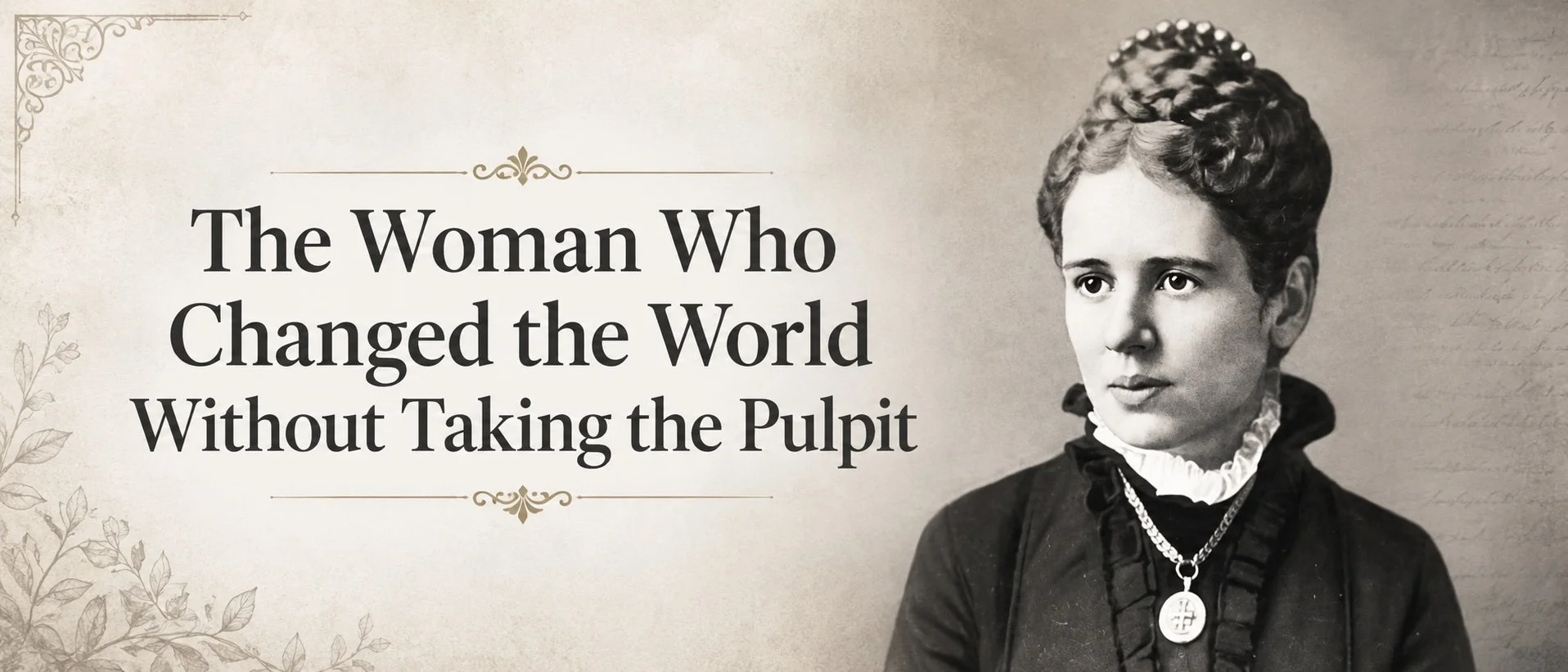
Twice a year, the Southern Baptist Convention reaches into its pockets at the bidding of a long past saint. In the cold of December, the plate goes round for the nations, and it carries the name of Lottie Moon. In the thaw of spring, it goes round again for this continent, and it carries the name of Annie Armstrong. Between them, these two offerings have gathered something north of six billion dollars, and Baptists have become dangerously close to treating them like patron saints.[1] We name our daughters after them. We hang their portraits in our mission rooms. And we have managed, with the kindly carelessness of people who love a legend more than a record, to forget that on the very question now dividing the convention, whether the office and the work of the pastor belong to men, the two of them stood on opposite sides of the line.
Let me be quick and clear about what they shared, because it was a great deal, and because the contrast I am drawing is not a quarrel between a heroine and a villain, nor am I attempting to criticize the contributions they made in the service of Christ. Both women were orthodox in their convictions and were dedicated to serving Christ with all of their might. Both of them were burdened and felt the reality and seriousness of the need for the gospel to go to the lost who are in desperate need of the good news, with a zeal that is needed today. Here is an important item: they were not rivals; they were comrades. It was Annie Armstrong who organized the first Christmas offering that sent reinforcements to Lottie Moon in China, and it was Armstrong who proposed that the offering carry Moon’s name. If you are hunting for a feud, or believe I am trying to create one, I am not, and there isn’t. What there is, is something more useful: two faithful women who answered the same question, and one that has continually been discussed over the past several years, what is a woman to be and to do in the house of God?
Lottie Moon’s answer, in the end, was to climb the fence. The Foreign Mission Board had sent her out under a rule confining single women to teaching children and visiting women in their homes, and Moon came to regard that rule as “a theft of her gifts.” So she began to preach to men. “I hope you won’t think me desperately unfeminine,” she wrote home in 1876, “but I spoke to them all, men, women and children.”[2] Her own modern biographer, the historian Regina Sullivan, no complementarian, but a clear admirer, puts it without hesitation: Moon broke with the Baptist tradition that reserved public preaching to men, and spoke to men whenever the occasion arose.[3] She wished, as she said, to be “responsible to God and not to man.”[4] One may honor the courage in desiring to answer to God alone and still see plainly where it points: the very God-breathed Scriptures that gave Baptist parameters in the first place.
Annie Armstrong’s answer was the opposite, and she held it not from a place of perceived persecution or patriarchal overreach into her ministry. She was no friend of the women’s rights movement of her age. She held that a woman ought not to speak before men, and she would not do it herself, not once, not for any cause, however good. She insisted that the women’s societies under her command defer to and support the pastors of their own churches.[5] And when the question came whether Baptist women should strike out on their own, collecting and spending their own money, sending their own missionaries, free of male oversight, it was Armstrong who drafted the constitution that bound the Woman’s Missionary Union to the Convention as an auxiliary, deliberately denying it those very powers.[6] She did this, mark it, against fierce resistance from men who feared that any women’s organization at all would slip the leash.[7] She proved them wrong by restricting it herself. Annie was a woman who could out-organize, out-write, and out-work every man in the denomination, and who chose, on principle, to pour all of it through a channel that left the men’s offices untouched and the men’s pulpits unentered.
That choice is why Annie Armstrong, and not Lottie Moon, is the woman this movement should be claiming. The confession the convention adopted in 2000 says that “the office of pastor is limited to men as qualified by Scripture.”[8]In 2023, the messengers removed two churches for keeping women in pastoral roles and tightened the language to read “pastor/elder/overseer.”[9] Twice since, in 2024 and again in 2025, they have tried and narrowly failed to write the rule into the constitution itself.[10] And this very week, in Orlando, Albert Mohler will ask them to do it again, with an amendment barring any cooperating church from affirming a woman “in the office or function of a pastor,” specifically by preaching to the gathered church.[11] The hinge word, as it has been for three years running, is function. And function is precisely the ground Annie Armstrong staked out and held for eighteen years: she demonstrated, as almost no one before or since, that a woman may carry staggering function in the work of God while leaving the pastoral office and the pastoral act wholly to men, not because she was incapable of more, but because she believed the order of the house was not hers to rearrange and Scripture sets the house rules.
She didn’t merely assent begrudgingly; she believed it cheerfully. This is the part our age finds hardest to credit, that a woman of her gifts could submit to that order without resentment and call it joy. “What a glorious thing it is,” she wrote, “to be a co-worker with God in winning the world for Christ.”[12] Co-worker—not overseer, not preacher, not the figure in the chair, but co-worker, and glorious. When the union finally voted to pay her, she would not take the money; she said she was glad to make an offering of her time.[13] There is no trace in her of the “wasted powers” that ached in Lottie Moon, nor what is being described today by many. Armstrong did not feel the boundary as a wound or a limitation. She felt it as a place to stand and work, and from that place she moved more for missions than any man of her generation.
So, let me cut to the chase of why I decided to write this article, if you haven’t figured it out yet. I cannot tell you what Annie Armstrong would say to the messengers in Orlando, because she died in 1938 and left no word on an amendment that did not yet exist. I will not put a speech in a dead woman’s mouth; that is the sort of liberty her friend Lottie took with the boundaries, not the type Annie took with anything. But I can tell you, from the whole shape of her life and the plain testimony of the record, where she would stand in Orlando, and the record leaves almost no room for doubt. The woman who would not address a roomful of men would not vote to let a woman preach to one. The woman who chained her own vast authority to an auxiliary, on purpose, against the wishes of men who would gladly have given her more, would not now move to unchain the pastorate. And she would, I think, grieve, not gloat, grieve, to see her dear friend’s restless impatience with the fence become the rallying cry of a movement to pull the fence down. For Armstrong loved Lottie Moon and gave the offering her name. But Armstrong did not preach to men, and she knew the difference between a woman who pours out her life under God’s order and a woman who steps across it. She spent her own life proving you need not step across it to change the world.
I want to be careful not to conscript Annie Armstrong as a culture-war mascot, because she would have despised the role, and because the women on the other side of this question are not her enemies or mine. Many of them love the gospel and the lost as fiercely as she did. The billboard they have raised this week on the road into Orlando, “God calls women to pastor, preach, and minister,” is deeply mistaken, I believe, but it is not cynical.[14] It is the cry of real women who feel real gifts straining against a real boundary, exactly as Lottie Moon felt them straining in a Chinese schoolroom. These women, who have been permitted to serve in areas where they shouldn’t have but were allowed to by weak men, and now have created this movement over an office that they never should have been allowed to step into in the first place, are now crying out in protest. The answer to that cry is not contempt. The example for them to look to is Annie Armstrong, a woman who felt the gifts no less, and who found in submission to God’s order not a smaller life but a larger one.
So, my question is for those still on the fence, or for those who believe that limiting the office, role, and function of pastor to biblically qualified men somehow diminishes women in ministry: no, it does not. This is not an effort to push women out of the church, silence them, or shove them into some forgotten corner. It is an effort to honor the boundaries God Himself has established. Scripture does not restrict women in order to diminish them. It restricts certain offices in order to protect the order, beauty, and faithfulness of Christ’s church.
The goal is not to keep women from serving, but to free them to serve fully, faithfully, and fruitfully in every way Scripture permits. Annie Armstrong is a powerful example of this. She was not “a good little Baptist girl doing her duty.” She was a woman on mission for Christ. She gave her life to the work God had set before her without grasping for an office God had not given her. Annie Armstrong wrote seventy-seven thousand letters and never preached a sermon. She helped drive a denomination’s mission engine and never sat in a pastor’s chair. She out-labored countless men and never demanded their office. She did not climb the fence. She built the kingdom right up against it.
That is the pattern. And would to God we had the wisdom to follow it, and the courage to tell her story, and ours, with the honesty Annie Armstrong would have demanded. I hope this little history lesson has given you a slightly better perspective on what the conversation is about, and the example we see in Annie Armstrong of how women have served and can serve in ministry, be great examples, and affect the world for the glory of God, without becoming pastors.
[1]“On Mission for Jesus: Annie Armstrong’s Easter Story,” Baptist Press, April 13, 2006. Armstrong organized the first Christmas offering, which sent three missionaries to assist Lottie Moon, and the offering was named for Moon at Armstrong’s recommendation.
[2]Lottie Moon to the Foreign Mission Board, 1876, quoted in Regina D. Sullivan, “Lottie Moon,” World Religions and Spirituality Project, September 18, 2020, https://wrldrels.org/2020/09/18/lottie-moon/.
[3]Sullivan, “Lottie Moon.” Sullivan, an admiring scholarly biographer rather than a confessional advocate, states that Moon broke with the Baptist tradition reserving public preaching to men and spoke to men whenever the occasion arose.
[4]Lottie Moon, 1879, quoted in Sullivan, “Lottie Moon.” See also Moon’s 1883 lament over “wasted powers” in “The Woman’s Question Again,” Woman’s Work in China (November 1883): 48.
[5]“Woman’s Missionary Union,” Encyclopedia of Alabama, https://encyclopediaofalabama.org/article/womans-missionary-union-wmu/. The entry records that Armstrong was no supporter of the women’s-rights movement, held that women should not speak before men, declined to address mixed audiences herself, and insisted that local societies defer to and support their own pastors.
[6]“Annie Walker Armstrong,” Southern Baptist Historical Library and Archives, https://sbhla.org/biographies/annie-walker-armstrong/. Armstrong led in framing a constitution that made the WMU auxiliary to the Convention rather than an independent body able to collect and administer its own funds and send its own missionaries.
[7]“Annie Armstrong,” Wikipedia; and “Woman’s Missionary Union,” Encyclopedia of Alabama. The WMU was organized over fierce resistance from male SBC leaders who feared a strong women’s body would slip beyond the Convention’s control.
[8]The Baptist Faith and Message (Nashville: Southern Baptist Convention, 2000), art. VI, “The Church.”
[9]“SBC Amendment to Permanently Ban Women Pastors Falls Short,” Christian Post (Saddleback and Fern Creek removed at the 2023 New Orleans meeting by roughly 88 and 92 percent); and “A 2023 Amendment to the BF&M 2000,” The Pathway (Missouri Baptist Convention), August 10, 2023 (Article VI amended to “pastor/elder/overseer”).
[10]“Southern Baptists Narrowly Reject Ban on Congregations with Women Pastors,” CBS News, June 12, 2024 (the Law Amendment failed the required two-thirds on its second vote); and “Vote to Bar Churches with Women Pastors Fails Again at SBC Meeting,” Religion News Service, June 11, 2025 (a kindred measure received 60.74 percent).
[11]R. Albert Mohler Jr. announced the “Truth & Unity Amendment” on May 18, 2026, proposing to add to Article III of the SBC Constitution that a cooperating church does not affirm, appoint, or endorse a woman serving in the office or function of a pastor/elder/overseer, specifically by preaching to the assembled congregation, and to suspend Standing Rule 6 for a vote at the June 9–10 Orlando meeting; a constitutional amendment requires a two-thirds majority in two consecutive years. See “Mohler to Propose Constitutional Amendment on Women Pastors,” Baptist Press; and “Mohler Refines Focus of Proposal,” WORLD.
[12]Annie Armstrong, quoted at AnnieArmstrong.com (North American Mission Board). The fuller saying is, “What a glorious thing it is to be a co-worker with God in winning the world for Christ.”
[13]“Who Is Annie Armstrong?” Lifeway Voices, https://voices.lifeway.com/discipleship-evangelism/who-is-annie-armstrong/. Armstrong refused payment for her work, saying it was a joy to make an offering of her time; the same profile notes she stood about six feet tall and led with formidable determination.
[14]“Baptist Women in Ministry Places Billboard ahead of SBC Meeting,” Baptist Standard, June 2026. The billboard near the Orlando convention center reads, “God calls women to pastor, preach, and minister.”